Rise of Dragons: War
- 4.5
- Rating
- 10.00K
- Installs
- Free
- Price

 Analysis by App-foxy
I went into Rise of Dragons: War expecting a quick strategy game with an aerial theme, but its appeal is more specific than that. The main attraction is the feeling of directing a battle from above: make a choice, watch the attack unfold in three-dimensional space, collect the result, and then decide whether the next improvement is worth another round. That action-and-response pattern is what kept me playing longer than I initially planned.
This is a free strategy game from SKYWORK AI Pte.Ltd., built around intense 3D aerial combat rather than slow, abstract map management. It is aimed at Teen players, and the presentation clearly favors dramatic encounters over a quiet, spreadsheet-like command experience. I found it easiest to enjoy in short sessions, although the progression structure encourages returning when I have enough time to make another meaningful upgrade or try a different approach.
The game is available on Android from version 7.0 onward. It had a 4.5 average from around 982 ratings when I reviewed it, with more than 10K installs, which suggests a modest but interested player base rather than the scale of a long-established genre giant. It is free to start, while optional purchases range from $0.49 to $99.99 per item. That price range matters because the game’s long-term comfort depends on whether you are happy to progress patiently instead of treating every obstacle as something to buy past.
You May Also Like

 AccuWeather: Weather Radar
AccuWeather Review: A Quick, Clear Forecast for Everyday Decisions
For everyday plans, the best forecast is the one you can understand quickly. AccuWeather makes rain timing, radar, and local conditions easy to act on, with a few trade-offs.

 Hill Climb Racing
Why Hill Climb Racing Still Turns Crashes Into One More Run
A tiny car, a bumpy hill and one more upgrade: Hill Climb Racing keeps resurfacing because its simple chaos makes every near-miss feel personal.

 AliExpress - Shopping App
AliExpress Makes Global Shopping Feel Personal, but Shoppers Bear the Risk
AliExpress turns a global marketplace into a pocket-sized discovery engine. Its reach is useful, its shopping loop compelling, and its trade-offs easy to miss.

 Lords Mobile: Kingdom Wars
Lords Mobile Is a Kingdom-Building Routine, Not a Quick Match
A case-by-case verdict on the building, battles, device demands, and social commitments that make Lords Mobile rewarding for some players and exhausting for others.

 PDF Scanner app - TapScanner
TapScanner Makes Paperwork Easier to Capture, Check, and Share
TapScanner makes scanning with a phone feel less like a rescue operation and more like a dependable step in getting work done. Its capture tools are useful, though not flawless.

 Block Blast!
 Shows How Much a Puzzle Game Can Leave Out
A quiet grid game shows why puzzle players increasingly value instant clarity, repeatable skill and low-pressure play—and where the genre still needs to catch up.
More From Our News Desk
View All News


How the first action creates the hook
The first thing I noticed was that the aerial setting gives ordinary strategy decisions more visual weight. In a traditional strategy game, selecting an attack can feel like pressing a button on a menu. Here, the three-dimensional combat framing makes the outcome easier to read as an event: an assault begins, the battlefield reacts, and the result gives me a reason to reconsider my next move.
I do not think the game is trying to replace a full-scale tactical simulator. Its strength is accessibility. You can understand the basic appeal quickly, even if you are not already familiar with complex strategy systems. The opening experience works because it offers an immediate question: should I act now with what I have, or wait until my forces and resources are in a better position?
That question becomes more interesting when I stop treating every encounter as a simple test of strength. A strong-looking attack can still feel wasteful if it leaves me poorly prepared for what follows. Conversely, a smaller action may be useful when the goal is to learn how the battle responds or to secure enough progress for the next improvement. The game rewards attention to timing, not just enthusiasm for launching attacks.
For a new player, my advice is to avoid spending everything immediately after the first successful battle. The early reward can create the impression that constant upgrading is always correct, but keeping a little flexibility is more useful. I prefer to observe what kind of challenge is coming next, then improve the part of my setup that addresses that problem instead of upgrading automatically.
This is also where the aerial theme helps the game stand apart from familiar fantasy strategy titles. Dragons and flying combat give the encounters a more aggressive identity than a standard army-versus-army board. The presentation is not merely decorative in my experience; it changes how I read the battlefield. I am watching for the impact of an attack and the consequence of positioning or timing rather than only comparing static numbers.
The small decisions behind a dramatic attack
The most useful habit I developed was separating “can I win?” from “what will winning cost me?” A victory that consumes too many resources may leave the next attempt less comfortable. That trade-off gives the combat loop some texture, especially when I am trying to build momentum rather than celebrate one isolated result.
I also found that the game suits players who like visible feedback. If you need every decision to produce a clearly explained tactical lesson, the experience may feel lighter than a demanding competitive strategy game. But if you enjoy making a choice and immediately seeing a dramatic response, the aerial presentation does much of the work of keeping the first action satisfying.
One realistic use case is a short evening break. I can start with one battle, review what changed, and decide whether I have enough time for another attempt. The game does not require me to reserve an entire afternoon before it becomes enjoyable. At the same time, the possibility of another upgrade or better result makes it easy to continue beyond the original plan.
The feedback rhythm: action, result, and adjustment
The core rhythm is straightforward: I take an action, the combat produces a result, I receive progress or resources, and I use that outcome to prepare for another encounter. That loop is more important than any single battle because it determines whether the game feels like a sequence of meaningful choices or just repeated tapping.
For me, the feedback works best when I pay attention to the difference between immediate success and useful progress. A win is enjoyable, but the more valuable question is what it unlocks for the next session. Did it give me enough room to improve? Did it reveal a weakness? Did it encourage me to change my approach rather than repeat the same move?
That makes the game more approachable than a highly technical strategy alternative, but also less satisfying for players who want deep control over every unit and battlefield variable. The design appears focused on maintaining momentum. It wants me to understand the result quickly and move toward the next decision instead of pausing for a long analysis after every exchange.
I recommend treating the combat feedback as a learning tool. When an attack fails or feels inefficient, I would not immediately repeat it with a purchase. I first look at the sequence of decisions that led there. If the same approach keeps producing the same problem, that is a sign to adjust the setup or timing. This simple pause prevents the game from becoming an expensive cycle of retrying without learning.
The 3D presentation contributes to that rhythm by making the reward feel connected to the action. In a menu-driven strategy game, the result can be reduced to a number changing on a screen. Here, I get a stronger sense that the battle itself caused the result, even when the underlying progression is still organized through upgrades and rewards.
Where the rhythm can lose momentum
The main limitation is that repetition can become noticeable if I approach every encounter in exactly the same way. The aerial theme creates a strong first impression, but visual intensity alone cannot carry a long session. Once the initial excitement settles, the quality of the loop depends on whether I feel that each new attempt teaches me something or improves my position in a satisfying way.
This is why I prefer playing in controlled bursts. A short session keeps the action feeling purposeful. If I continue after the decisions start to blur together, the game becomes less strategic and more like routine maintenance. Players who enjoy constant optimization may be comfortable with that, but I think casual players will get more from it by stopping after a clear milestone.
Compared with the usual alternatives in the strategy category, this game is better suited to someone who wants combat spectacle and a quick response than to someone seeking a slow campaign built around diplomacy, construction planning, or intricate resource chains. If your favorite strategy games are mostly about examining a large map and planning several turns ahead, the aerial combat focus may feel too direct. If you want an accessible battle loop with a stronger action feel, it is a more natural fit.
Rewards that make another session tempting
The reward stage is where the game turns a completed battle into a reason to return. I like that the result is not the true endpoint. The reward gives me a choice: improve immediately, save for a larger change, or use the new progress to attempt a challenge that previously felt inefficient.
That choice is more important than the reward itself. If I spend everything automatically, the progression becomes passive. If I hold resources forever, I miss the satisfaction of becoming stronger. The most enjoyable balance is to reserve enough for a planned improvement while keeping a small amount of flexibility for an unexpected difficulty.
My practical tip is to connect every upgrade to a problem I have actually encountered. If I struggled to finish an engagement efficiently, I want the next improvement to address that issue. Spending simply because an option is available can make progress feel faster for a moment, but it gives me less information about why the next battle went better.
The free entry point is useful here. I can test the basic loop without paying before deciding whether the progression is worth my time. However, the optional purchase range means that players should decide early how they want to approach spending. I would recommend treating purchases as convenience rather than a requirement and setting a personal limit before the game’s reward cycle makes an immediate upgrade feel urgent.
That advice is especially relevant for younger players, since the game carries a Teen content rating. A parent or guardian who allows access should be comfortable with the possibility of optional purchases and should discuss spending expectations beforehand. The rating also signals that the presentation is not aimed at very young children, so I would not recommend choosing it as a family game for small kids simply because the dragon theme looks colorful.
The reward loop is strongest when I can see a direct connection between patience and improvement. Waiting for a better opportunity, preserving resources, and returning with a clearer plan make the next battle feel earned. That is more satisfying than using a purchase to erase every difficult moment, although players who dislike waiting may find the slower path frustrating.
Who benefits most from the progression
I think the best audience is someone who enjoys strategy in compact sessions and likes watching a combat decision produce a visible result. It also works for players who are drawn to dragons and aerial battles but do not want to learn an intimidating system before having fun. The game gives enough structure to encourage planning without demanding that every action be treated like a tournament move.
I would be more cautious if you want a completely non-repeating experience, a story-heavy role-playing game, or a strategy title where every unit has extensive manual control. This is not the right choice for someone who wants to spend most of the time designing a city, negotiating with factions, or solving a large campaign puzzle. A more traditional strategy alternative will likely offer greater depth in those areas.
It is also not ideal if you find free-to-play progression distracting by default. Even when I choose not to purchase anything, the existence of optional items changes how I evaluate the reward cycle. The game remains approachable as a free download, but the best experience comes from being deliberate about whether I am playing for the battles or chasing every available improvement.
Resetting the session without losing the reason to return
Every session eventually reaches a natural reset. I finish an encounter, collect the result, make an improvement or save my resources, and then leave the game until I am ready to test the next decision. That reset is important because it prevents the loop from feeling like one endless battle. I return with a new objective rather than simply continuing out of habit.
The most effective reset for me is to end after a meaningful change. That might be completing a difficult encounter, gathering enough progress for a planned improvement, or learning that my current approach is not working. Stopping at that point makes the next launch feel purposeful. I already know what I want to test, so I am not opening the game without a plan.
This is also a useful way to manage the game’s more repetitive side. Instead of trying to force a long session, I treat each return as a small experiment. I choose one adjustment, watch how it affects the next battle, and then decide whether the result justifies continuing. That approach makes the feedback clearer and reduces the feeling that I am grinding simply because the game expects me to.
For a busy player, this structure is convenient. A quick session can still provide a complete arc: action, result, reward, and a decision about what comes next. For a dedicated strategy player, the same structure may feel too compact if they want a broader campaign with consequences that unfold across many hours. The reset is a strength for accessibility, but it also defines the game’s limits.
The current version I played was 1.370.020801, and the game has been available since May 26, 2025. Those details place it in a relatively early stage compared with long-running strategy franchises, so I approach it as a focused aerial combat experience rather than a mature replacement for every type of strategy game. Its identity is clearest when I judge it by the quality of its repeatable loop.
A better way to decide whether to keep playing
After each session, I ask myself three practical questions. Did my choice change the battle in a way I could understand? Did the reward give me a useful next step? Do I want to test a specific adjustment rather than merely collect more progress? If the answer is yes, the next session has a real purpose. If the answer is no, taking a break is better than forcing the loop.
This method also helps answer whether the game deserves space on a phone or tablet. If you like short strategy sessions with a strong visual combat layer, the free download makes it easy to try. If you need a deep, fully transparent system with no purchase pressure and extensive long-term planning, you may be happier with a premium strategy game or a more established competitive alternative.
My verdict on the complete action loop
What keeps me coming back is not simply the promise of dragons or the 3D battles. It is the compact structure: I commit to an action, receive clear combat feedback, turn the outcome into progress, and reset with a reason to try again. When I play thoughtfully, each session feels like a small decision-making exercise rather than a string of disconnected attacks.
The game is at its best when I use patience as part of the strategy. I save resources when an immediate upgrade would be wasteful, change my approach after an inefficient result, and stop once the current objective is complete. Those habits reveal more depth than the store summary suggests, while also showing where the experience can become repetitive if I play without a goal.
I would recommend it to a friend who wants an accessible 3D aerial strategy game with quick feedback and a dragon-focused identity. I would explain that the free starting point is attractive, but optional purchases mean it is wise to set spending boundaries. I would also say that the game is more rewarding in short, intentional sessions than in an uninterrupted marathon.
My final view is positive but specific: Rise of Dragons: War is a good fit for players who want the excitement of aerial combat wrapped in a manageable strategy loop. It is not the deepest alternative for campaign planners or simulation fans, and its repetition becomes easier to notice when every battle is approached the same way. Still, when I treat each return as a new test rather than a demand to grind, the action, feedback, reward, and reset form a satisfying reason to begin another session.
FAQs for Rise of Dragons: War
01What is the primary gameplay of Rise of Dragons: War?
Rise of Dragons: War is a strategy-based game where players build and manage their own kingdom while training dragons for battle. The game involves resource management, strategic planning, and engaging in epic battles against other players or AI opponents. It focuses heavily on alliances and strategic warfare.
02Is Rise of Dragons: War free to play?
Yes, Rise of Dragons: War is free to download and play. However, it offers in-app purchases that can enhance gameplay by providing resources, special items, and faster progression. These purchases are optional, but they can significantly influence your success and speed in the game.
03What are the system requirements for Rise of Dragons: War?
For Android users, Rise of Dragons: War requires Android version 5.0 or higher. iOS users need iOS 10.0 or later. The game is optimized for both smartphones and tablets, but a stable internet connection is necessary for seamless gameplay, as it involves real-time battles and interactions.
04How does multiplayer interaction work in Rise of Dragons: War?
Multiplayer interaction is a key feature of Rise of Dragons: War. Players can form alliances with others, participate in global events, and engage in PvP battles. Communication with other players is facilitated through in-game chat, enabling strategic planning and alliance coordination.
05Are there any age restrictions for playing Rise of Dragons: War?
Rise of Dragons: War is rated for players aged 12 and up due to its fantasy violence and strategic gameplay elements. Parents should be aware of the game’s social features, as they involve interactions with other players, which might require supervision for younger audiences.
Pros
- Stunning graphics with vibrant details
- Engaging storyline with frequent updates
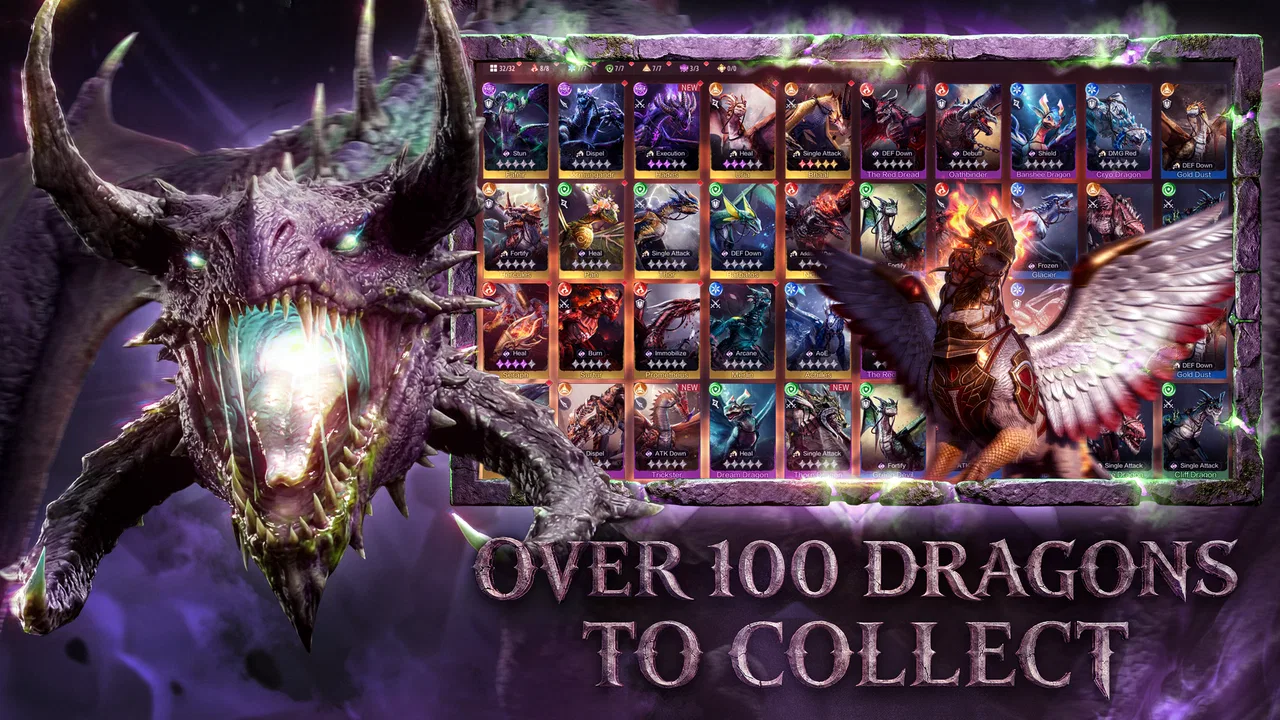
- Diverse dragon types to collect
- Interactive multiplayer battles
- Intuitive controls for easy gameplay
Cons
- Requires constant internet connection
- High battery consumption
- In-app purchases can be pricey
- Occasional server lag issues
- Limited offline gameplay options

Rise of Dragons: War
Gallery